Wednesday, October 18, 2006
Tuesday, October 17, 2006
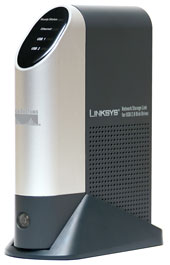
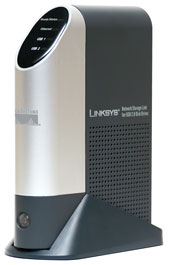
Linksys NSLU2 Network Storage Link Review

In my previous post, I did a review of a network storage product by D-Link, which turned out to be not only slow, but generally defective. I still, however, need some network storage, so I have since returned the DSM-600 and have come home from CompUSA with Linksys’s NSLU2.
I. A Slightly Different Concept
The NSLU2 is much smaller than the DSM-600 because it is a different type of product. Unlike the DSM-600, the NSLU2 is not a hard drive enclosure—thus there is no space inside of the machine to put a hard drive in. Instead, the NSLU2 simply has two USB 2.0 ports and a single network port. Thus, you take your existing external hard drives and plug them into the back of the NSLU2 and then connect it to your router.
The NSLU2 also has no wireless antenna and, therefore, cannot serve as an access point or a range extender.
II. File Systems
I mentioned in a comment on my previous post that a significant drawback of the DSM-G600 was that it forced you to format any hard drive you connected to it and then use a Linux file system! Unlike an NTFS and FAT32 file system that Windows supports, a Linux EXT2 file system is UNREADABLE if not connected directly to your network storage unit.
So what does this mean?
First, this means that if you already have a few hard drives full of media you want to share, then you’re screwed because you need to erase all the data on the hard drive before you can “share” it. This sounds even dumber when you consider the fact that no one will want to purchase one of these products UNLESS they already have a ton of media that they would like to share. Is anybody out there saying, “Hmm. I have absolutely no music and movies or documents I need to share in my home network, so how about I invest in home network storage now?” What makes it even more infuriating is the way that companies market these products, saying that they allow you to “Share music, video, or data files” but neglect to mention that you’ll need to get all of those after you’re forced to format your hard drives.
Second, this also means that if you ever need to physically move your hard drive (let’s say you’re going on a trip and want to bring it home for the holidays), you’re going to need to not only lug around the entire network enclosure, but you’ll need a router wherever you go to hook the damn thing up. Moreover, you’ll need to bring the setup disks with you because the home network you add it to is completely unconfigured.
Third, if you ever decide to ditch the network storage box and still want your media on your hard drives, a Windows PC will NOT be able to read those hard drives anymore because EXT2 isn’t natively read on PCs. There is a way to recover the files using a Linux Reader utility, but this is very slow going (it can take days).
As you can see, the use of Linux file systems is a serious drawback of NAS (Network Attached Storage) today. The worst part is that the manufacturers do not list that they use EXT2 ANYWHERE on the outside of the box, and in some cases don’t even mention it in their product manuals. During setup of the DSM-G600, for example, it simply tells you that it is reformatting the hard drive without any warning, so quite a few people have probably lost all of their data thinking that it was going to be shared, not erased.
How stupid are the engineers who came up with these products? How near-sighted do you have to be to let something like this get through to the retail shelves?
Well, with all of these problems with file systems, I was quite delighted to see on the box of the NSLU2 the following message: “Supports Windows NTFS and FAT32 File Systems!” That would actually solve a lot of my problems.
III. Installation
I brought the NSLU2 home and plugged it in. The setup process was a little clunky and counter intuitive, and it was virtually impossible to figure out how to actually see the hard drives on my computer. I started out by plugging in the first hard drive I wanted to share. This was an NTFS drive. And because none of the product packaging says it will or will not erase my data, I did not put much data on the hard drive just to test it out.
Error message: “Unsupported File System.” I thought NTFS was supported, you know, based on the front of the packaging that says NTFS is supported. Apparently not. I plugged in another hard drive I had, this one with a FAT32 file system. Same error message. I plugged them into either port and nothing happened.
Oh and by the way, every time I unplugged a hard drive, I had to reboot the entire NSLU2 and go through the setup process again. I found this out in the fine print of the product manual which says, “The NSLU2 is not hot swappable.” That’s odd isn’t it? Every time I want to share something on a new drive on the network, I need to reboot the entire machine? That sounds counter to what Linksys advertised on their product packaging: “You can even plug a USB flash disk into the Network Storage Link, for a convenient way of accessing your portable data files.” Two things about this marketing strategy. First, is anyone really going to come home with a USB flash drive and then plug it into their home network if they need to reboot the entire machine and disrupt access to the other hard drive as well? NO. Second, who the hell is walking around with a USB flash drive that has a EXT2 file system on it?? No one, that’s who.
IV. Tech Support
I got through to Linksys’ tech support line, which didn’t require a long wait, but did force me to talk to technicians who had strong Canadian and Indian accents, which are virtually impenetrable, even by my standards. I finally got someone I could understand and he says, “The NSLU2 CAN support NTFS and FAT32 file systems, but not outside of the box. You’ll need to update your firmware in order to do this.” So I’m thinking that this is complete bullshit that it says it does support it, but actually doesn’t, but the other part of me thinks, ‘Hey it’s a quick download, so why not?’
I download the firmware and try to install it and get an error message. It turns out you need a hard drive attached to the NSLU2 while upgrading the firmware, and guess what, that hard drive won’t be recognized until your FORMAT the hard drive and erase all of your data. Thus, in order to have support for NTFS and FAT32 file systems, Linksys forces you to ERASE those file systems first. What a complete debacle.
So I decided I would just format one of my harddrives and then reformat it back to NTFS later on. I look at the release notes of the firmware and it says, “Port 2 only supports NTFS/FAT32. Port 1 supports EXT2 only.” What the hell? That seems quite arbitrary.
After the firmware upgrade, the machine would only recognize the Linux formatted disk, but not disks from any other file system. After an hour I figured out that the release notes were simply wrong because they mixed up the port numbers. Port 1 only supports NTFS/FAT32 and Port 2 is the one with EXT2 only. How can you manage to foul that up, too, Linksys?
V. Using it . . . sort of
Even assuming that I am willing to forgive Linksys for blatant and predator false advertising, and even assuming I am willing to use a machine that I need to reboot every time I swap out a hard drive, and even assuming that I am willing to format one of my hard drives using a Linux file system—I still wouldn’t be happy with this product.
First off, it is damn near impossible to keep this thing connected to your computer. The hard drives show up as network drives, but they keep cutting in and out. The performance is lackluster (2MB-3MB/second, which is atrocious for a wired home network).
Then I discovered something else. Lets say I have some music on network hard drive 1 and I am listening to it on my computer. I would be streaming a small amount of data from that drive. It turns out that if anybody on the network accesses either network hard drive 1 or 2 for any reason, all connections to the hard drive cut out for a few seconds.
What is the purpose of SHARING your media with MULTIPLE users on a home network when that same machine can only access one hard drive at a time and CUTS OFF all other users in doing so?
The answer: No purpose at all.
VI. Conclusion
Linksys’s NSLU2 is quite possibly one of the most horrific products I have ever purchased. It is false advertised, buggy, slow, and a general piece of shit (that’s an industry term). Needless to say I returned the NSLU2 to CompUsa immediately for a full refund.
1.5 out of 10. Stay away!
By
A.H. Rajani
at
10/17/2006 11:32:00 AM
4
Comments
Tuesday, October 10, 2006
D-Link DSM-G600 Network Enclosure Review

Two words: Great Idea
Two more words: Manufacturer's Recall
D-Link's DSM-G600 Network Enclosure is an amazing idea in theory. A network enclosure is basically an empty box that you can add a hard drive to. On the back of the unit is a network port and a wi-fi antenna. Thus, you can connect the enclosure to your router or existing network.
What's the purpose of this? You can share media in your entire house without having to leave your computer on all of the time. You can stream video or audio to any devices in your home as well. You can also get access to all of your files when not at home (provided you have a stable internet connection). The DSM-G600 also has two USB ports on its back. This enables you to plug in additional hard drives and make those shared on the network as well.
The DSM-G600 was bought for me as a gift. I put a 500GB hard drive in mine and turned it on. Setup was not too bad, and the drive was working for a few days. I did notice that even though the manufacturer claimed gigabit speeds, the performance was not much faster than a standard network connection. Either way, I was just sharing music, so that is not too bandwith intensive.
After three days the unit just shut off and turned back on. It did it again and again. And then, it didn't turn on again at all. The power switch was broken. I called D-Link and they were quick to tell me that my unit was defective. In fact, the whole line of DSM-G600's were defective because of a recall on their system boards.
What was their solution, you ask? "We'll ship you another unit." Hmm. Let's think about that one for a bit. This technician just told me that ALL of their products are defective, and now they want to send me a replacement defective product? I asked how they could ensure that this unit won't be defective and the technician said, "We can't guarantee that." On top of that, they wanted me to pay for shipping! D-Link can kiss my ass.
Well, after about two or three minutes of assorted varieties of verbal abuse, I told them to have a great day. I am returning the unit directly to Best Buy, where I purchased the product. It's amazing that Best Buy didn't pull the product from their shelves when they knew about it. Compusa apparently took the product off of their shelves 8 MONTHS ago because of this recall.
By
A.H. Rajani
at
10/10/2006 09:34:00 AM
2
Comments
Thursday, October 05, 2006
Authentication Security Codes
What I have noticed lately is that these security codes are getting quite elaborate--and increasingly difficult to decipher. So many of them have these ridiculous looking artifacts in them and are stretched so badly that they are practically beyond recognition. I think I have about a 40% chance at getting it right the first time. And on some sites, if you get the security code wrong, it throws you out and forces you to enter in all of your information again.
I understand that this is a feature designed to prevent fraudulent registrations, but I figure that if a literate human being can't recognize the characters, then the system itself is flawed.
By
A.H. Rajani
at
10/05/2006 01:08:00 AM
1 Comments
Monday, October 02, 2006
Citi Rewards: "Thank You" . . . for letting us devalue your points
Citi has a fairly robust credit card rewards program detailed in an earlier post. However, like the steady decline of JetBlue's rewards program, Citi too has begun to tighten its belt.
Gift Card Price Change: On September 29, 2006, the required points to redeem $25 and $50 gift cards changed. The new point values are as follows:
$25.00 Gift Cards - 3,500 ThankYou Points
$50.00 Gift Cards - 6,000 ThankYou Points
There goes my habit of purchasing $50.00 gift cards at Shell. I suppose I'll redeem my points for $100.00 gift cards, which still generally require 10,000 points.
Go to hell, Citi.
By
A.H. Rajani
at
10/02/2006 10:55:00 PM
0
Comments
Saturday, September 30, 2006
Google Suggest Beta
Google Suggest Beta is a search tool I have mentioned before on this blog. It is a replacement for your standard Google homepage, the only difference being that as you type your search terms, Google provides a real-time list of suggestions along with a result total for each listing. Interestingly, if I type "www," the first suggestion Google offers is actually "www.yahoo.com" which is pretty odd considering that this is Google's service.

By
A.H. Rajani
at
9/30/2006 09:24:00 PM
1 Comments
Friday, September 29, 2006
Tuesday, September 26, 2006
5 Myths Debunked
- Meg White is identified as Jack White's TD Ameritrade consultant
- Toyota's new RAV4--now only inches shorter than the Hummer H3--is recalled when researchers discover a Toyota Tercel lodged inside its engine compartment
- Duracell's strong market performance is traced back to allegations that the Energizer Bunny used performance-enhancing drugs
- Thaksin Shinawatra, Thailand's former-Prime Minister, failed to return home to address civil unrest because Thai International Airlines refused to transfer his "Super-Saver" fare
- A significant decrease in viruses reported on the latest Windows Vista release candidate is a result of Microsft's campaign to keep its customers safe by "disabling the internet"
By
A.H. Rajani
at
9/26/2006 11:36:00 AM
0
Comments
Saturday, September 23, 2006
Rule for the New Fall Lineup
All 1-hour dramas must have at least one song by The Fray in it.
By
A.H. Rajani
at
9/23/2006 09:45:00 AM
0
Comments
Tuesday, September 19, 2006
Day Casebeer Madrid & Batchelder

It's official. I've accepted an offer as an Associate with an intellectual property litigation boutique in Cupertino, CA called Day Casebeer Madrid & Batchelder ("DCMB").
The only sad part about this process is having to say no to another firm that I also enjoyed working at named Morrison & Foerster. I was lucky enough to be in the position where I had two great choices. So for anyone thinking about interviewing at MoFo, I'd encourage it and add that there is a reason it is consistently ranked one of the best companies to work for in the United States. I don't think a comparison of the two would be very fruitful, especially because they are different types of practices.
Just a few remarks and general thoughts on DCMB:
I worked at DCMB the summer after my first year of law school and also returned for a short stint during this past summer. I worked very hard, but loved the work, the people, and the general demeanor of the firm. People know how to joke around, but get down to business at the same time, which is a surprisingly difficult balance to achieve. My own motto for practicing:
Take your work seriously, but leave yourself out of it!
DCMB is much smaller than most full-service law firms. DCMB has approximately 30 attorneys right now. The Firm specializes in IP litigation, handling high-stakes patent cases for clients including QUALCOMM and Amgen, among others. I think one of the things that sets DCMB apart from other firms is that it combines long-term attorney/client relationships with a willingness to turn down cases that are not of ultimate strategic importance to the client. I think in reality, most large IP firms will take almost all of the cases they can get, dropping only those cases in which there is a conflict of interest. The reasoning behind this is that with a large enough firm, you can always staff a large case or just hire new people in case you need more help.
At first it seemed to me that a lack of bandwith might hurt DCMB's long-term viability, but the Firm's size has, in fact, had the opposite effect. The Firm is in a great position to pick and choose the cases it wants, avoiding the problem of expanding too fast by taking on to many attorneys. It also avoids the--often underrated--problem of conflicting yourself out of the market by taking a few too many cases. DCMB is small, though it is small by choice, which is admirable especially because boutiques are very hard to come by these days. This, of course, doesn't rule out the possiblity that the Firm will expand as time goes on, but it will expand on its own terms.
The final thing I will mention that drew me to the working environment has to do with a quasi-intangible quality of the litigators training and working at DCMB. The only way I can describe it is that I am surrounded by people who take the time to appreciate the art of litigation--that is--encourage a style of advocacy that does not shy away from nuanced arguments and creativity.
People ask me if I'm psyched now that I've chosen a firm to work with. The answer is, I'm not quite sure. Apart from having to make a tough decision and turn down another great firm, the reality is that I won't start working full time until a whole year from now, which means it is difficult to get excited for something so far in advance.
This brings me to another topic, the BAR Trip. I'll post some thoughts on this in a few days.
By
A.H. Rajani
at
9/19/2006 12:08:00 PM
0
Comments
Saturday, September 09, 2006
Sunday, August 27, 2006
Saturday, August 12, 2006
Rescue Me - Comedy Short
By
A.H. Rajani
at
8/12/2006 12:26:00 AM
0
Comments
Saturday, August 05, 2006
Passwords
Some sites require 5 or more characters for your password, while others require 8 or more. Some sites require that you include a special character and some give you the option while others prohibit special characters altogether. Some sites say you can't have any numbers, while others require them. Some sites say you need at least one capital letter, some give you the option while others are case sensitive, others require all lower case letters and a few require all uppercase letters. A few sites will not let your password include any known English words. I came across a new password rule today that I haven't seen before: no repeating characters.
The worst part is that even if I were to pick a completely random set of characters and commit it to memory, I still would have to remember at least fifteen different passwords--not to mention the different usernames, which have their own ridiculous conventions.
By
A.H. Rajani
at
8/05/2006 02:04:00 PM
2
Comments